
Ways to Market Your Small Business in 2026!
Updated on: March 30, 2026
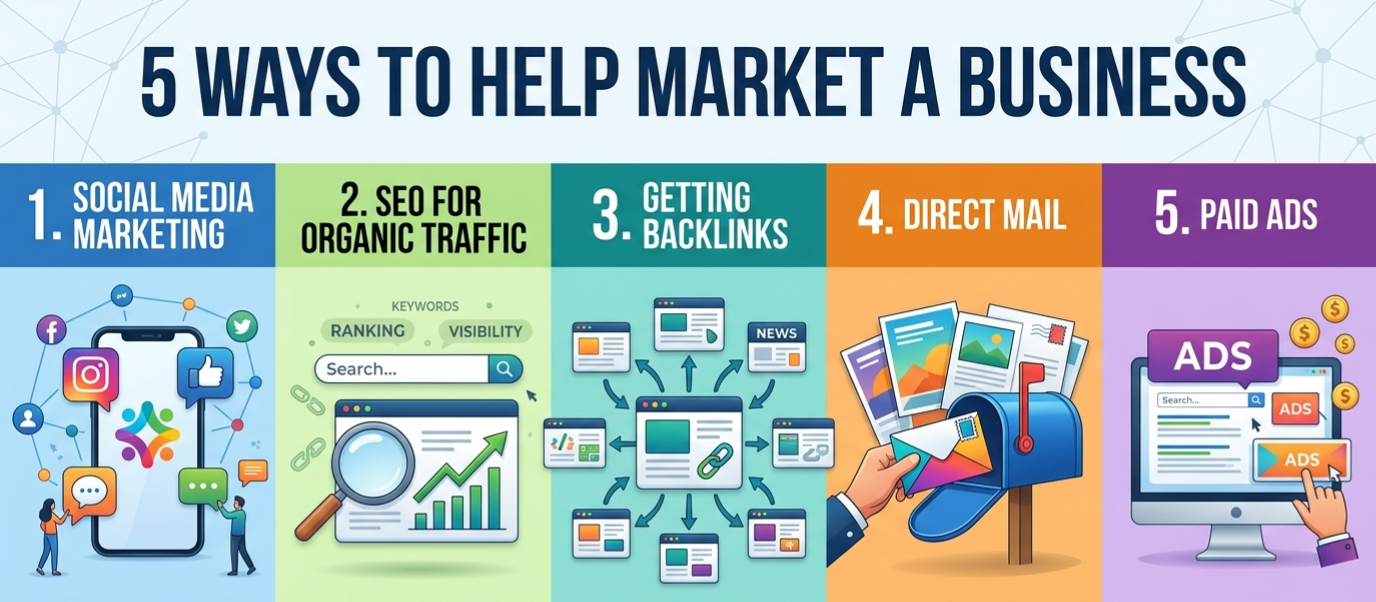
In today’s fast-paced digital world, effective small business marketing strategies can make the difference between staying afloat and thriving. Whether you're a local service provider or an e-commerce brand, getting in front of the right customers is essential. Below, we explore the best ways to market your small business using proven techniques—ranging from cutting-edge SEO and Google Ads to old-school direct mail marketing.
1. Social Media Marketing: Instagram and LinkedIn for Small Businesses
In 2026, social media marketing is still one of the most cost-effective ways to grow a small business. But choosing the right platform is key.
Instagram: Ideal for B2C Marketing
If you sell to consumers (retail, cleaning, fitness, food), Instagram for small business is your visual playground.
Use Instagram Reels and Stories to showcase behind-the-scenes, testimonials, or before-and-after results.
Use a program like Canva.com to create social media reels and posts.
You can also use AI programs that help manage your socials. They can create and post content for you, making it manageable to post on a consistent basis.
Optimize your Instagram business profile with keywords and links.
LinkedIn: Best for B2B Outreach
LinkedIn marketing is a goldmine for service-based businesses like law firms, IT, janitorial cleaning companies, etc.
Post client case studies, employee spotlights, professional advice, info about your industry, products, services, etc.
Join local groups and engage with decision-makers in your industry.
💡 Pro Tip: Link your social media profiles back to your website to boost domain authority through high-quality backlinks.
*See the definition of “Backlinks” and “Domain Authority” at the bottom of the page.
2. SEO: Boosting Organic Website Traffic
Search Engine Optimization (SEO) is a long-term strategy, but it consistently delivers the highest ROI in digital marketing. In 2026, Google's algorithms prioritize quality content, fast load times, mobile usability, and E-E-A-T (Experience, Expertise, Authoritativeness, Trustworthiness).
Research these three terms to get a better understanding of what google and other search engines are looking for with the integration of AI: AEO (Answer Engine Optimization), GEO (Generative Engine Optimization), and SEO (Search Engine Optimization)
On-Page SEO Must-Haves:
Keyword-optimized titles, headers, and meta descriptions.
Internal links to relevant pages on your site.
Regularly updated blog content answering search queries.
Local SEO Tactics:
Set up and optimize your Google Business Profile.
Collect and respond to online reviews.
Use local citations and geo-tagged images.
If this feels overwhelming, there are many helpful tutorials on YouTube that walk through each step.
Businesses that optimize for local SEO can see significant growth!
3. Backlinks: The Authority Builders
Backlinks—when another website links to yours—are like digital votes of confidence. High-quality backlinks tell Google that your site is trustworthy, which helps you climb search rankings.
How to Build Backlinks:
Create high quality content so other websites link to your website.
Publish guest posts on industry blogs or local business directories.
Get listed on reputable directories like Yelp, BBB, and Angi.
Create shareable content like infographics, case studies, and expert guides.
Get high quality backlinks by using (HARO) Help A Reporter Out. This allows you to help bloggers and reporters find answers to requests that they put up on HARO, they will then link your website to the amazing websites they work for. You can focus on topics that you know best, related to your industry. Continue to create high quality content that answers relevant questions about your industry.
If you are just starting out, consider acquiring some backlinks for your website through: Medium.com, Nextdoor.com, Gravatar.com, About.me, Dreamwidth.org, or Livejournal.com - just to name a few. These sites have high domain authority and allow you to create a profile and link your website. For each of these sites just create a free account, set up your profile and make sure to add links to your website. These are easy backlinks to get! But don’t solely rely on these for backlinks, the golden rule for backlinks now is to earn them naturally by offering real value.
🔗 Tip: Focus on acquiring links from sites with high Domain Authority (DA). Tools like Moz or Ahrefs can help track your backlinks and domain authority.
4. Direct Mail Marketing: Postcards That Pack a Punch
Direct mail may seem old-fashioned, but it’s making a strong comeback. According to the Data & Marketing Association, 73% of American consumers say they prefer being contacted by brands via mail because they can read it at their convenience. This is a budget friendly option that yields results.
Why It Works:
Targeted delivery: You can mail only to homes or businesses within a specific ZIP code, profession, or income bracket.
Tangible and memorable: Today we get so many virtual ads, emails and calls to the point where it gets overwhelming. A well-designed postcard marketing campaign can stand out.
Tips for Success:
Use clear calls-to-action (CTAs). *See the definition of “CTA” at the bottom of the page.
Include limited-time offers to drive urgency.
Pair mailers with a landing page and a custom URL that people can look up. (If you have a webpage and social media accounts be sure to mention them on your postcards/mailers.
There are companies that you can pay to do this for you. But if your just starting out consider making something on Word and printing them out on some nice paper or cardstock. Then fold them up, stuff them in an envelope, get your targeted addresses, and send away! Make sure they look as professional as you can make them, practice makes perfect.
🔑 Pro tip include your website on the direct mail: Create a separate webpage with the special offer and some addition helpful" info for potential customers. Then put its URL on the Direct Mail. You can put the website URL on there (For example: yourwebsite.com/special-offer) or include a QR code that they can scan with their phone.
When you send out letters to potential customers, you will want to know if people actually visit your website after reading the direct mail. When someone scans that QR code with their phone or types in the URL it will take them to your special webpage you created. To track this use Google Analytics, it is a free tool that helps you see everything that happens on your website. Google Analytics will automatically track visitors from your QR code if your link includes tracking tags (UTMs). You can optionally create an event or mark it as a conversion if you want to measure results more closely. Your basically telling Google: “When someone visits my website using that QR code or special URL, make a note of it.” Once you do that, Google will count each person who visits from the direct mail. You’ll see the results in Google Analytics, and that helps you know if your mail campaign is working or not! This can get a little confusing if your just learning. Use AI and youtube to learn about Google Analytics and figure out how to get it set up.
📬 Examples of Effective CTAs on Business Postcards:
“Call now to schedule your free estimate!”
“Visit [YourWebsite].com and claim 20% off your first service.”
“Show this postcard and get a free upgrade!”
“Scan the QR code to book your cleaning today!”
5. Google Ads: Pay-Per-Click That Pays Off
If you're looking for immediate visibility, Google Ads for small businesses offers the best bang for your buck—especially for local services. Here you will need to invest a good amount of money but if done properly this will yield great results. Pairing ads with your organic efforts is like adding a turbo boost. While SEO builds your long-term visibility, ads give you instant exposure. Ads fill in the gaps while your organic traffic grows and put you in front of people searching for exactly what you offer. Plus, both together can reinforce your brand—people might discover you through an ad, and later return organically, increasing trust and overall traffic.
Benefits of Google Ads:
You appear at the top of search results instantly.
Only pay when someone clicks your ad.
Geo-targeting allows hyperlocal focus.
Best Practices:
Use location-based keywords, for example: “Plumbers in Chicago, IL” *See the definition of “Keywords” at the bottom of the page.
Use an A and B ads to see if one performs better.
Set up conversion tracking to measure ROI.
If you don’t understand any of this, don’t worry you can hire a marketing professional or use Google’s automated campaign tools to manage ads for you. But learning how to do this yourself will be not only great for your business but will open up many more doors of opportunity in the business world.
🔍 SEO Insight: While paid ads get clicks, organic rankings build long-term authority. Use both together for maximum reach.
*See the definition of “Organic Traffic” at the bottom of the page.
Final Thoughts
If you’re a small business looking to grow, combining strategic social media use, targeted mailers, Google Ads, and a solid SEO foundation is the path forward. These proven strategies not only improve visibility but also build credibility and long-term customer loyalty.
Don’t just market—market smarter.
Terms Defined:
Call to Action (CTA) is a clear, compelling instruction printed on the postcard that tells the recipient exactly what to do next. It’s the part of a postcard, website, social media post, or digital ad that drives engagement and motivates the reader to take a specific, measurable action—like visiting your website, calling your business, or redeeming a special offer.
SEO (Search Engine Optimization) is the practice of optimizing your website and online content to improve its visibility in search engine results—especially on Google. The goal of SEO is to help your site appear higher on the search results page when people search for keywords related to your business, products, or services.
Backlinks are links from one website to another. In simple terms, when another website links to your website, that’s called a backlink. Backlinks help improve your website’s credibility and search rankings. Tools like Moz may show this as an increase in Domain Authority.
Domain Authority (DA) is a score created by tools like Moz to estimate how strong your website is—Google does not use this score directly. The score ranges from 1 to 100, with higher scores indicating a stronger, more trustworthy website. Using tools like this will let you see a bigger picture of how your website is doing.
Keywords are the words or phrases that people type into search engines like Google when they’re looking for something—like a product, service, or answer to a question.
Organic traffic refers to the visitors who come to your website naturally, through unpaid search engine results—mostly from Google, Bing, or Yahoo.
