How Often Should a Janitorial Company Clean My Office?
Updated May 2026 | By Michael Flores — Empire Office Cleaning, Buffalo, NY
Short answer:
Most offices need daily restroom service and high-touch surface wipe-downs, weekly full floor care and dusting, and monthly detail work. Scale by headcount and traffic:
Small offices (under 10 employees): 1× per week — add a midweek touchpoint during cold and flu season
Medium offices (10–50 employees): 2–3× per week to keep restrooms and shared spaces properly maintained
Large offices (50+ employees or high visitor traffic): Daily janitorial service — one full cleaning per business day
Key takeaways:
Match your cleaning frequency to people and visitors — more traffic always means more cycles
Restrooms and high-touch surfaces (door handles, breakroom appliances, shared tech) are your highest priority, every single visit
Disinfect with EPA-registered products at the labeled contact time when illness has occurred; routine cleaning covers normal conditions
Use the ISSA Clean, Measure, Monitor framework to audit quality and right-size your schedule over time
Sources: ISSA Clean Standards (Institutional & Commercial), CDC Facility Hygiene Guidance, EPA Registered Disinfectants
Why Janitorial Cleaning Frequency Matters More Than You Think
Let's be real: most business owners don't think about cleaning frequency until something goes wrong — a restroom complaint, a sick-day wave, or a client walking out of a lobby that looked like nobody's been in it since 2019.
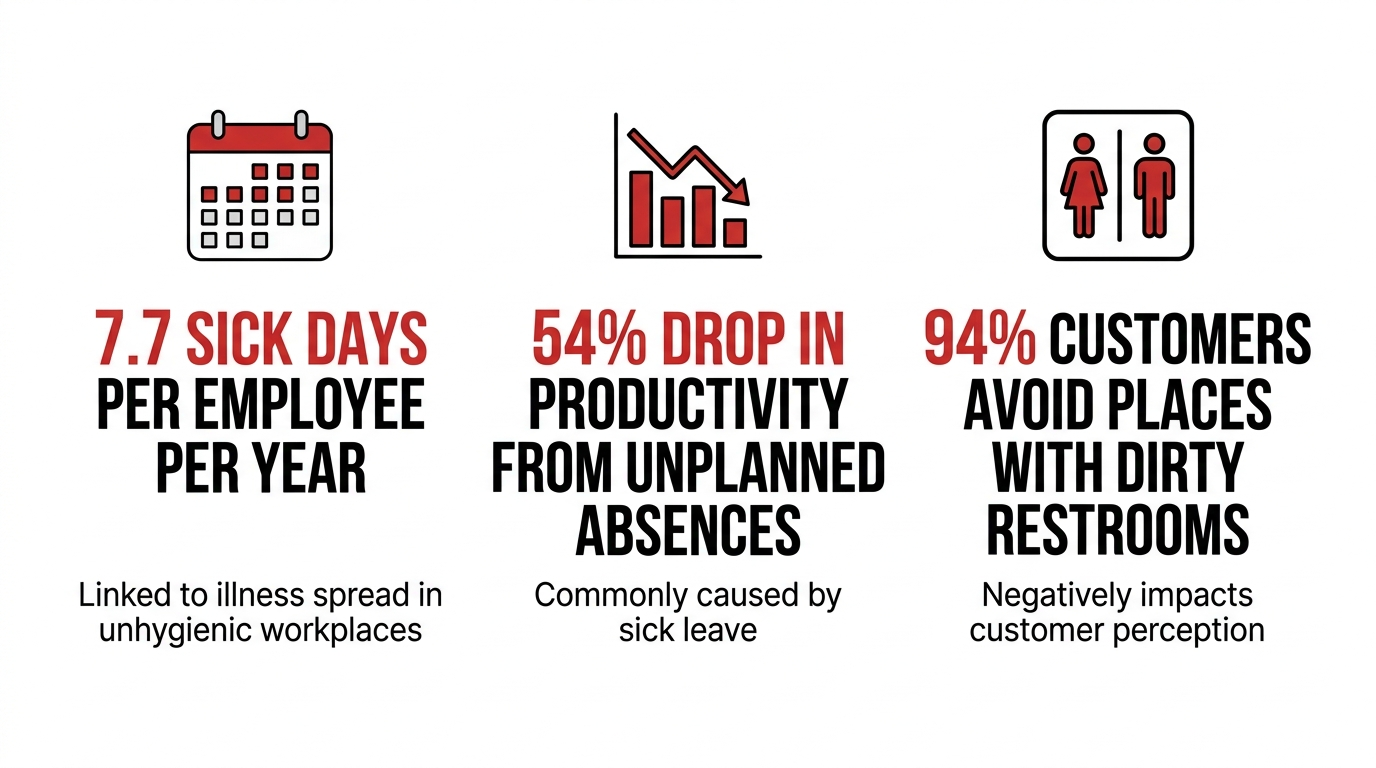
The International Sanitary Supply Association (ISSA) — the world's leading cleaning industry authority — puts hard numbers behind what experienced facility managers already know intuitively. According to ISSA's Value of Clean research:
Employees average 7.7 sick days per year, costing U.S. businesses an estimated $225.8 billion annually in lost productivity
An employee working while sick (presenteeism) experiences a 3–8% drop in performance, affecting cognitive skills like reasoning, memory, and creative thinking
A properly cleaned 100-person office paying average salaries of $25,000 can realize a productivity gain worth up to $125,000 per year — just from reduced illness-driven disruption
Unplanned absences caused by spreading illness create a 54% decrease in output and a 39% drop in sales or customer service quality
94% of customers say they would avoid a business in the future after encountering a dirty restroom
That's not a facilities talking point. That's a revenue conversation.
At Empire Office Cleaning, we've been servicing offices, medical facilities, fabrication shops, and warehouses across Greater Western New York since 2016. The businesses that get cleaning frequency right spend less money managing sick-day chaos and spend more time focused on their actual work. That's the whole point.
What Determines the Right Janitorial Cleaning Frequency for Your Office?
ISSA's current industry guidance is clear: cleaning schedules should be driven by a risk assessment of your specific facility, not a generic template someone found online. Here are the six factors we evaluate when building a custom janitorial schedule for any Western New York client:
1. Employee headcount and shift patterns More people means more surface contact, more trash generation, faster restroom demand, and higher particulate load on floors and air. Open-plan offices with shared workstations require more frequent intervention than private, single-occupancy spaces.
2. Visitor and client-facing traffic A professional services firm with daily client meetings looks and functions very differently from a back-office operation. Lobbies, reception areas, and conference rooms serving external visitors need more frequent high-touch and floor maintenance cycles than internal-only spaces.
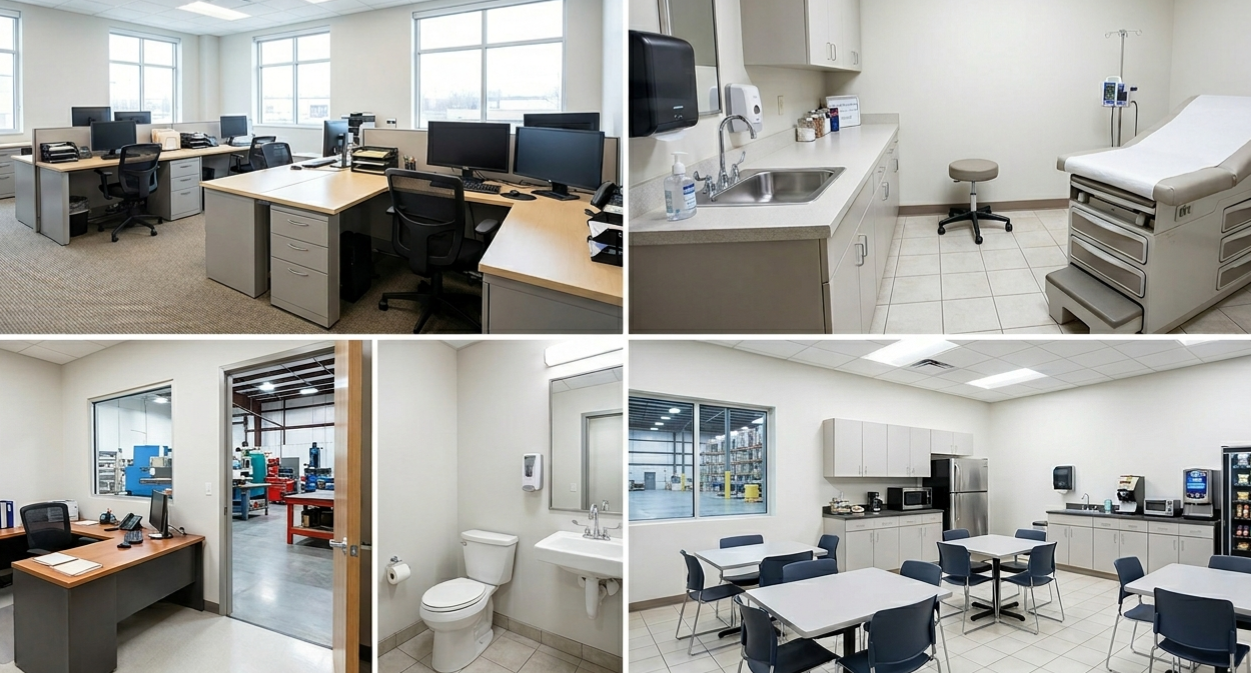
3. Facility type Not all commercial spaces are equal. A standard office in Cheektowaga has a different cleaning profile than a medical office in West Seneca or a fabrication shop office in Depew. Industrial and healthcare environments carry higher contamination risks and typically require more rigorous janitorial protocols, including EPA-registered disinfection procedures and specific PPE handling standards.
4. Seasonal demand in Western New York Buffalo winters are not theoretical. Cold and flu season runs October through April in this region, and it drives real pressure on shared surfaces and restrooms. A smart janitorial schedule flexes with that seasonal risk — it doesn't stay flat year-round and hope for the best.
5. Hybrid and variable occupancy ISSA's state-of-industry data confirms a shift toward risk-based, traffic-driven scheduling as hybrid work has changed how offices actually fill. If your building is at 30% capacity Mondays and Fridays but at full capacity Tuesday through Thursday, your cleaning schedule should match that reality. Cleaning empty rooms at full frequency is a waste; under-cleaning peak-occupancy days is a health risk.
6. Regulatory and lease requirements Medical offices, food-adjacent spaces, and multi-tenant commercial buildings in the Greater Buffalo area often have cleaning standards written into their lease, insurance requirements, or compliance obligations. Know your minimums before you negotiate a janitorial contract.
Daily, Weekly, Monthly, and Quarterly Office Cleaning Tasks
This schedule is grounded in ISSA's Clean, Measure, Monitor framework and aligns with CDC and EPA guidance on commercial facility hygiene. It's also what we actually use to build scopes of work for clients across the Hamburg, Orchard Park, Lancaster, and Lackawanna areas.
Daily (Every Service Visit)
These tasks happen every time our crew is in the building — no exceptions:
Restrooms Clean and disinfect all fixtures (toilets, urinals, sinks, and partitions), mop floors, replenish paper products, soap dispensers, and can liners. Restrooms are the single highest-risk area in any commercial facility. In any multi-person office, daily service is the floor — not the ceiling. High-traffic floors or public lobbies require multiple restroom checks per day.
High-Touch Surface Wipe-Downs Door handles, push plates, light switches, elevator buttons, handrails, conference room A/V controls, shared keyboards, desk phones, copy and printer panels. These surfaces are the fastest pathway for pathogen transfer in any commercial workspace. The CDC recommends cleaning high-touch surfaces routinely and disinfecting with EPA-registered products when illness has occurred or contamination risk is elevated.
Breakroom and Kitchen Areas Counter surfaces, tables, sink and faucet areas, appliance handles (microwave door, refrigerator handle, coffee machine), and spot-mopping as needed. Breakrooms combine food, moisture, and heavy shared contact — a combination that accelerates bacterial growth between service visits.
Trash and Recycling Removal All receptacles emptied and re-lined. Overflow and odor are early warning signs that cleaning frequency is too low for actual usage.
Entry Points and Lobby Glass Fingerprint and smudge removal at entry doors and lobby glass. First impressions are set in the first 10 seconds. For medical offices, industrial facilities, and multi-tenant lobbies, this isn't cosmetic — it's part of the professional image that keeps clients coming back.
Restroom Supply Audit Paper towels, toilet paper, and hand soap checked and restocked. Running out mid-day is an immediate complaint driver and an IAQ/hygiene issue.
Weekly Tasks
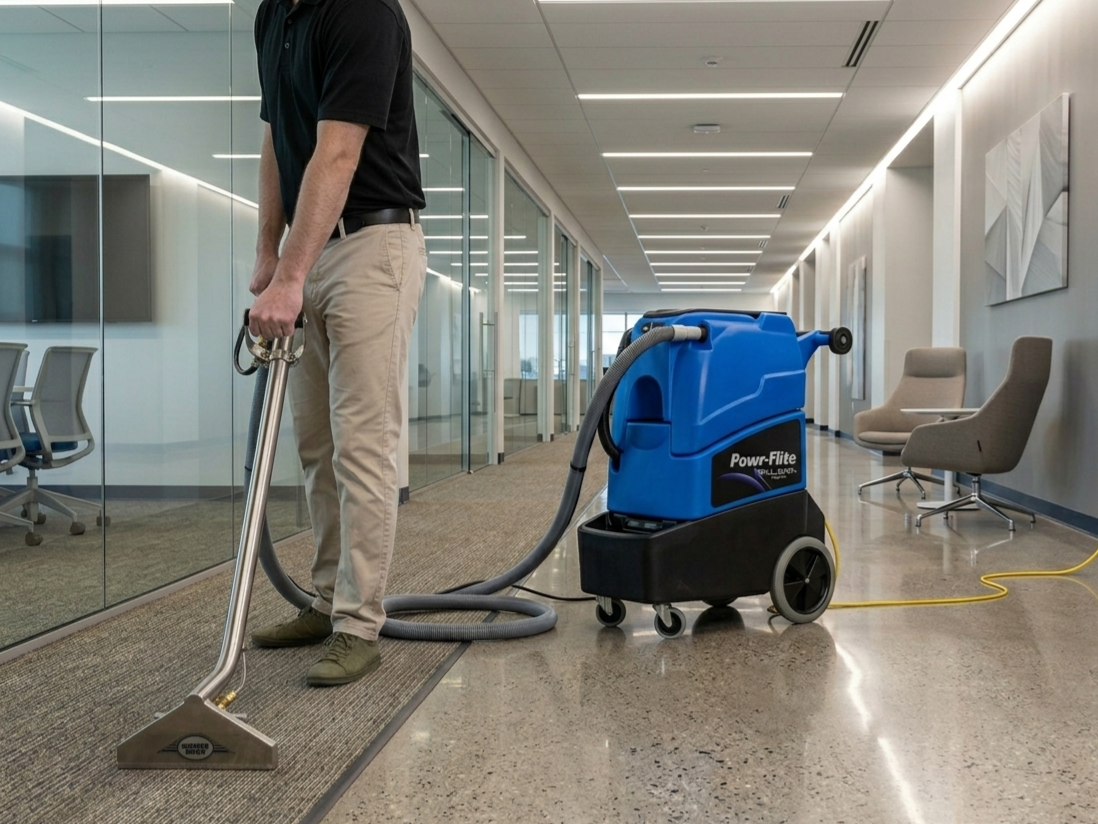
Full Floor Care Vacuum all carpeted areas using HEPA-rated equipment (preferred by ISSA to capture fine particulates rather than recirculate them into breathing air) and mop all hard surface floors using a clean microfiber flat-mop system. ISSA Cleaning Times standards provide production rate benchmarks for efficient, consistent execution at any facility size.
Surface Dusting Desk surfaces, shelves, window ledges, equipment exteriors (monitors, printers, copiers), and partitions. Dust accumulation is a significant indoor air quality factor — it doesn't just look bad, it directly affects the breathing environment and can trigger respiratory irritation.
Breakroom Appliance Wipe-Downs Deep clean of microwave interiors, coffee station exteriors, and countertop appliances — beyond the daily surface wipe.
Glass and Partition Cleaning Interior glass panels, office dividers, and window sills throughout the facility.
Monthly Tasks
Detail Work Baseboards, door frames, partition bases, and light switch plates — surfaces that accumulate grime gradually but visibly.
Vents and Grilles HVAC diffusers, return grilles, and exhaust fan covers. Per ASHRAE 62.1 ventilation standards, cleaning complements — but does not replace — proper HVAC filtration. Dusty grilles impede airflow and contribute to poor indoor air quality, which directly affects cognitive performance and comfort.
High Dusting Cobweb removal from ceiling corners, top-of-cabinet surfaces, and overhead light fixtures.
Quality Audit and Schedule Review Per ISSA's Clean Standard: Institutional and Commercial Facilities, a monthly review of task completion, tenant feedback, and spot ATP testing (where applicable) is recommended to right-size your program. If complaints are rising or areas are visibly missed, adjust before it becomes a client retention issue.
Quarterly Tasks
Chair and Furniture Bases Vacuum and wipe chair bases, casters, and the undersides of desk panels — areas that accumulate debris steadily but get overlooked in routine cycles.
Breakroom Refrigerator Remove expired food, wipe interior surfaces and shelves. In shared refrigerators, this should be scheduled — not left to employees who will do it never.
Carpet Spot Treatment Address staining patterns that weekly vacuuming doesn't resolve. This extends carpet life and delays the cost of full replacement or commercial extraction cleaning.
| Facility Type | Typical Frequency | Key Priorities |
|---|---|---|
|
Standard Office
10–50 employees
|
2–3× per week |
|
|
Large Office / Multi-Tenant
50+ employees
|
Daily |
|
|
Medical / Healthcare Office
Any size
|
Daily + Multi-Service |
|
|
Fabrication Shop / Light Industrial
Any size
|
2–3× per week |
|
|
Logistics Warehouse / Distribution
Any size
|
Weekly to 2× per week |
|
|
Conference / Event Space
Any size
|
Per Event + Weekly |
|
How Many Cleanings Per Week Does Your Office Actually Need?
Here's the honest version — because anyone who gives you a single number without asking about your building isn't being straight with you.
Small offices (fewer than 10 employees, minimal visitor traffic) One cleaning per week covers it under normal conditions. During cold and flu season — which in Buffalo means roughly October through April — add a midweek high-touch touchpoint to reduce transmission risk on shared surfaces.
Medium offices (10–50 employees) Two to three cleanings per week is the industry standard for this size range. Restroom demand alone typically justifies 3× per week once you have more than about 20 regular occupants. If you're running client meetings mid-week, add a pre-meeting check to the schedule.
Large offices and high-traffic facilities (50+ employees or significant visitor flow) Daily janitorial service. One full cleaning for every business day the building is occupied. If you're running multiple shifts or 24/7 operations, build a porter model or split-shift cleaning program to match actual usage patterns.
The honest tiebreaker If your restroom complaints are increasing and you're already at 2× per week, go to 3×. If you had a confirmed illness sweep through your team, increase high-touch frequency immediately and add an EPA-registered disinfection pass. Don't wait for it to happen twice.
Cleaning vs. Disinfecting — Understanding the Difference
This distinction matters operationally and is worth getting right before you spec a janitorial contract.
Cleaning removes visible soils, debris, and organic matter from surfaces. It reduces the number of microorganisms but does not kill them to a defined standard. This is what routine janitorial service accomplishes.
Disinfecting kills germs on pre-cleaned surfaces using EPA-registered products applied at the labeled concentration and contact time (the surface must stay visibly wet for the duration specified on the product label — skipping this step means the chemistry doesn't work).
When to clean: Every service visit, on all surfaces.
When to disinfect: When someone has been confirmed ill, when visible contamination has occurred, in high-risk environments (medical, food-adjacent, high public contact), or when your risk profile warrants it by season or occupancy type.
What that means for your contract: Don't pay for daily disinfection across every surface if you don't need it. Do ensure your janitorial provider is using EPA-registered disinfectants — List N or equivalent — when illness protocols are triggered. We're straight with clients about this at Empire Office Cleaning because overselling daily disinfection when routine cleaning is sufficient wastes your budget.
The 10 High-Touch Surfaces in Every Office
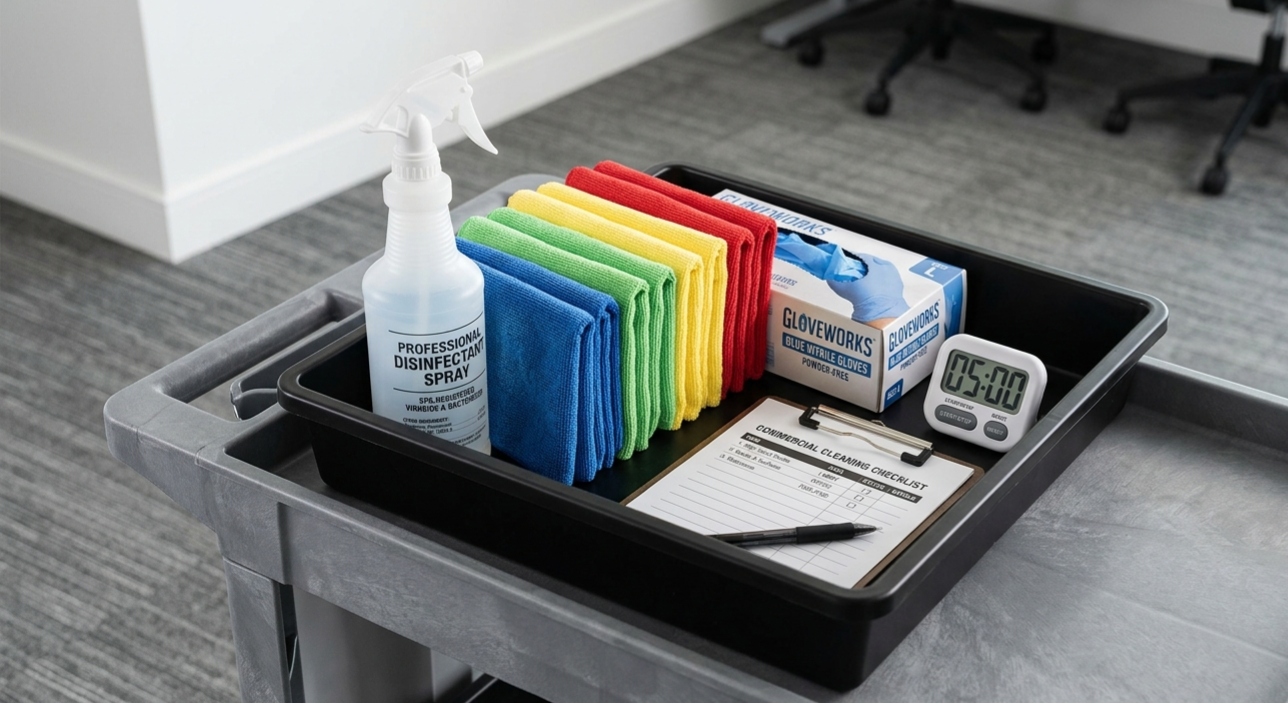
The CDC identifies routine cleaning of high-touch surfaces as a cornerstone of commercial facility hygiene. These are the surfaces we prioritize on every visit, regardless of facility type:
Door handles and push plates (entry, restroom, breakroom)
Light switch plates throughout the facility
Elevator buttons and call panels
Restroom fixtures — faucet handles, flush handles, soap dispensers
Breakroom appliance handles — microwave, refrigerator, coffee machine
Shared keyboards, mice, and desk phones
Conference room controls — A/V panels, speakerphones, table surfaces
Copy, print, and scan panels
Reception counters and sign-in surfaces
Handrails on all stairwells
This list is the non-negotiable floor for any commercial janitorial cleaning program. Everything else scales by frequency and facility type.
Restrooms and Breakrooms — How Often Is Enough?
More facility manager complaints originate in restrooms and breakrooms than anywhere else in a commercial building. Here's the straightforward answer:
Restrooms: Daily service for any facility with more than a handful of regular occupants. Multiple visits per day for high-traffic floors, public lobbies, or facilities serving outside visitors. The one-service-per-week model only works for very small, low-occupancy offices — and even then, it requires mid-week restocking checks.
Breakrooms: Daily surface cleaning at minimum. Appliance deep-cleaning weekly. Refrigerator purge quarterly. In shared-space environments where multiple teams use the same kitchen, daily frequency is non-negotiable for food safety and odor control.
If you're currently at weekly service and breakroom or restroom complaints are a recurring issue, that's your signal — not a facilities nuisance to manage around.
| Approach | What It Covers | Best Fit | Notes |
|---|---|---|---|
|
Nightly Full Cleaning
After hours
|
Complete reset — floors, restrooms, trash, and high-touch surfaces | Medium to large offices | No disruption to staff; consistent quality window every visit |
|
Day Porter
Midday touchpoints
|
Restrooms, high-touch areas, and spot spills during peak use hours | High-traffic lobbies, multi-tenant buildings | Reduces mid-day complaints; improves real-time facility perception |
|
Hybrid Model
2–3× per week + porter
|
Structured full cleans plus real-time response on peak-occupancy days | Growing teams, variable foot traffic | Most flexible model; scale porter hours up or down by season |
|
Event / On-Demand
Project-based
|
Pre- and post-event resets, move-in/out, and project completion cleans | Conference centers, project-phase spaces | Always pair with a baseline weekly or nightly program |
|
Industrial / Warehouse
Weekly to 2–3×
|
Floor safety lanes, break areas, restrooms, and entry point maintenance | Fabrication shops, logistics facilities | Safety is the lead priority; task scope differs from standard office programs |
| Task | Frequency | Why It Matters |
|---|---|---|
| Restrooms: fixtures, floors, restock | Daily | Hygiene, odor control, tenant satisfaction |
| High-touch surfaces (handles, buttons, shared tech) | Daily | Reduces pathogen transfer risk |
| Breakroom surfaces, sink, and tables | Daily | Food safety, shared-space hygiene |
| Trash and recycling removal | Daily | Odor, pest control, overflow prevention |
| Entry glass and lobby surfaces | Daily | Client-facing first impression |
| Vacuum carpets (HEPA equipment preferred) | Weekly | Allergen and dust reduction; IAQ support |
| Mop all hard surface floors | Weekly | Appearance; slip/fall risk reduction |
| Dust surfaces, equipment, and partitions | Weekly | IAQ and professional appearance |
| Vents, grilles, and ceiling fans | Monthly | Airflow, IAQ, ASHRAE 62.1 alignment |
| Baseboards, door frames, and detail surfaces | Monthly | Accumulated grime; professional appearance |
| High dusting (cobwebs, light fixtures) | Monthly | Appearance and allergen reduction |
| Quality audit and schedule review | Monthly | Right-sizes frequency; catches gaps early |
| Breakroom refrigerator purge and wipe | Quarterly | Food safety, odor prevention |
| Chair bases and furniture undersides | Quarterly | Debris buildup; professional appearance |
Quality Monitoring: How to Know If Your Cleaning Program Is Working
A janitorial contract is not set-and-forget. ISSA's Clean Standard: Institutional and Commercial Facilities recommends a structured Clean, Measure, Monitor loop — the same framework we use internally at Empire Office Cleaning:
Define: Establish a written scope of work with specific tasks, frequencies, and responsible areas. If it's not in writing, it doesn't get done consistently.
Audit: Conduct regular visual inspections using a checklist format. For facilities with higher hygiene standards — medical offices, food-adjacent spaces, or facilities that have had illness events — ATP meter testing provides an objective measure of surface contamination beyond what a visual pass catches.
Adjust: Use audit findings and tenant feedback to right-size staffing and cleaning cadence. If complaints cluster around restrooms on Wednesday afternoons, add a midweek restroom check. If high-dusting feedback comes up quarterly, move it to every 6 weeks.
The goal is a cleaning program that improves over time — not one that stays at the original spec regardless of how the building actually gets used.
Cleaning, Indoor Air Quality, and Your HVAC System
Cleaning reduces surface contamination and removes settled particulates from floors and surfaces. It does not replace ventilation. Per ASHRAE 62.1 standards (the benchmark for acceptable indoor air quality in commercial buildings), proper mechanical ventilation and filtration work in concert with a sound cleaning program — neither substitutes for the other.
In practical terms for Western New York offices:
Weekly HEPA vacuuming removes allergens and fine dust from carpet that would otherwise become airborne with foot traffic
Monthly vent and grille cleaning prevents accumulated debris from re-entering the airstream
Breakroom humidity and odor management (daily cleaning + exhaust fan maintenance) keeps moisture-related air quality issues from developing
If your team is experiencing frequent respiratory complaints, headaches, or fatigue, have both your cleaning program and your HVAC filtration reviewed. One rarely fixes the problem without the other.
What to Do After a Confirmed Illness in Your Office
This comes up more often than most facility managers expect — and the protocol matters:
Clean first. Remove visible soils and organic material from all affected surfaces. Disinfectants don't perform correctly on dirty surfaces.
Disinfect with an EPA-registered product. Use a List N or equivalent disinfectant at the label concentration and full contact time. The surface must stay wet for the contact time specified — for most products, that's 30 seconds to 4 minutes.
Increase high-touch frequency temporarily. Add a disinfection pass on door handles, shared tech, breakroom surfaces, and restroom fixtures for the following 5–7 business days minimum.
Coordinate with your janitorial provider and HR/Operations. Your cleaning company needs to know. Your employees need to know what steps were taken. Transparency here is part of the protocol.
Review your baseline frequency. If an illness sweep happened once, it can happen again. Use it as a trigger to reassess whether your current cleaning schedule matches your actual occupancy and risk profile.
We're direct with our clients when the situation calls for it. If an illness event is circulating through your building and your current program isn't adequate, we'll tell you — and we'll tell you what a correction looks like.
Summary: Build Your Office Cleaning Schedule Around Your Building
The right janitorial cleaning frequency comes from two things: the people in your building and the spaces they use. Start with daily restrooms and high-touch wipe-downs as your non-negotiable baseline. Layer in weekly floor care and dusting. Add monthly detail and quarterly deep work. Then scale frequency up by headcount, visitor traffic, facility type, and season.
If your current program isn't keeping up — if restroom complaints are recurring, if your team is regularly sick, if the breakroom looks like nobody owns it — the schedule isn't matching the reality of how your building is being used.
Empire Office Cleaning builds custom janitorial programs for offices, medical facilities, fabrication shops, and warehouses across Buffalo, Hamburg, Cheektowaga, West Seneca, Depew, Orchard Park, Lancaster, and the surrounding Erie County area. We'll take a look at what you have, tell you honestly what we think you need, and build a scope that actually fits your building and your budget.
Schedule a Free Consultation →(716) 425-1853 | mflores@empireofficecleaning.com
FAQ
1. How do I decide between 2× and 3× per week service? Count your regular occupants and honest restroom usage. If you have more than 20 regular staff sharing restrooms, 3× per week is usually the right call. If mid-week complaints are coming in at 2×, that's your answer — add the day.
2. Does my office need daily disinfection? Not necessarily. Routine cleaning of high-touch surfaces is appropriate for normal office conditions. Use EPA-registered disinfectants at labeled contact times when someone has been confirmed ill, when your risk profile is elevated (medical offices, high public contact), or during peak illness season. Don't pay for daily disinfection across the board if your facility doesn't warrant it.
3. What counts as a "high-touch surface" in a commercial office? Door handles, push plates, light switches, elevator controls, faucet handles, soap dispensers, microwave and refrigerator handles, shared keyboards and mice, printer panels, conference room controls, and reception counters. These get attention every visit.
4. Are restrooms always daily? Yes, for any facility with regular multi-person occupancy. Increase to multiple visits per day in high-traffic environments. The only exception is a very small, low-use private office — and even then, mid-week restocking checks are advisable.
5. Does cleaning frequency affect indoor air quality? Directly. Weekly HEPA vacuuming and monthly vent cleaning remove particulates that affect air quality and cognitive performance. Pair with proper HVAC filtration per ASHRAE 62.1 for full IAQ management — cleaning handles surfaces; ventilation handles the air.
6. How do we verify our cleaning program is working? Regular visual inspections using a checklist, tenant and staff feedback, and periodic ATP surface testing for higher-risk environments. ISSA's Clean, Measure, Monitor framework provides the methodology — we apply it in our own quality audits at Empire Office Cleaning.
7. What do we do after a confirmed illness in the office? Clean first, then disinfect with an EPA-registered disinfectant at labeled contact time. Increase high-touch frequency for 5–7 days minimum. Notify your janitorial provider and coordinate with HR. Then review whether your baseline schedule needs to be adjusted.
8. Does Empire Office Cleaning serve industrial and warehouse facilities? Yes. We work with fabrication shops, light industrial facilities, and logistics warehouses across Western New York. Cleaning scopes for industrial environments differ from standard office programs — floor safety lanes, dust control, restroom demand, and breakroom hygiene are the lead priorities.
Ready to see what this looks like for your facility? Check out our full range of services or browse our FAQ for quick answers.
Author: Michael Flores is owner of Empire Office Cleaning and a janitorial and facility services expert with 10+ years designing commercial cleaning programs for offices, medical facilities, and industrial spaces across Western New York. Connect on LinkedIn: linkedin.com/in/michael-flores-13b30123b| Learn more at empireofficecleaning.com